
Unschooling Is Not What You Think It Is
The most common reaction to unschooling is some version of: “So you just… don’t teach them anything?”
It’s completely wrong. But it’s worth understanding why people arrive there, because the misunderstanding reveals something about our assumptions regarding learning itself.
Unschooling might be the most misrepresented approach to education in existence. It gets dismissed by people who’ve never looked at it, defended with almost religious fervor by people who practice it, and caricatured by both sides of the homeschooling debate. Here’s what it actually is, what it isn’t, and why understanding it matters even if you never practice it.
What unschooling is
Unschooling starts from a premise that sounds radical but is well-supported by developmental psychology: children are natural learners. Not in a vague, inspirational-poster way. In a concrete, observable way. Human children are biologically driven to understand their environment, acquire language, develop social skills, and build competence. This is what childhood is for, evolutionarily speaking.
Unschooling says: instead of replacing that natural drive with a structured curriculum, support it. Create a rich environment. Be an engaged, available parent. Facilitate access to materials, experiences, and people. Answer questions. Ask questions. Go to the library, the museum, the woods, the kitchen. And then trust the process. Not inspirational-poster trust. The difficult, day-to-day kind where you watch your child spend three hours on something that looks like nothing and resist the urge to redirect.
An unschooling day might look like a ten-year-old spending the morning building an elaborate Minecraft world (spatial reasoning, resource management, creative problem-solving), the afternoon cooking lunch with a parent (fractions, chemistry, sequencing, nutrition), and the evening reading a novel they chose themselves (vocabulary, narrative comprehension, empathy). There’s no lesson plan. There’s no checkbox. But there’s a tremendous amount of learning happening.
The parent’s role isn’t passive. This is the misconception that does the most damage. Unschooling parents are often more engaged than traditionally schooling parents, not less. They’re constantly observing, facilitating, connecting, and enriching. They notice a child’s interest in volcanoes and arrange a trip to a geological museum, check out twelve books on plate tectonics, find a YouTube series by an actual volcanologist. The child leads. The parent makes the path walkable.
What unschooling is not
It’s not neglect. Neglect is when a child’s needs go unmet. Unschooling is an intentional educational approach that requires enormous parental presence and attention. If a parent is using “unschooling” as a label for disengagement, they’re not unschooling. They’re just not educating.
It’s not chaos. Most unschooling families have rhythms, routines, and structure. They eat meals together. They have bedtimes. They have expectations about behavior and contribution to the household. What they don’t have is a mandated academic schedule. The absence of a curriculum is not the absence of order.
It’s not “letting kids do whatever they want.” Unschooling gives children autonomy over their learning, not their entire existence. Parents still parent. They still set boundaries. They still say no. The freedom is specifically about what and when and how a child learns, not about whether they have to wear a seatbelt.
It’s not anti-intellectual. Some of the most voracious readers, deepest thinkers, and most creative minds come from unschooling backgrounds. When you remove the compulsion from learning, many children learn more, not less. They just learn different things at different times than a traditional scope and sequence would prescribe.
The legitimate concerns
The criticisms deserve honest engagement, because some of them are real.
Gaps. Unschooled children will have gaps in their knowledge. They might be fourteen and not know the order of the planets, or twelve and shaky on long division. This is true. It’s also true of traditionally schooled children; the gaps are just different and less visible because everyone has the same ones. The question isn’t whether gaps exist but whether they matter. An unschooling parent would argue that a motivated teenager can learn long division in an afternoon if they need it, and they’re probably right. The prerequisite for filling a gap is caring about what’s in it.
Socialization. This comes up for all homeschoolers, but unschoolers get it double because the assumption is that without a structured class environment, children never learn to navigate social dynamics. In practice, unschooled kids tend to socialize in mixed-age groups (co-ops, community classes, sports teams, neighborhood kids), which is actually more representative of real-world social life than a room of thirty same-age peers. But this does require parents to actively create social opportunities. It doesn’t happen by default.
College and careers. This is a real consideration. Unschooled teens who want to attend traditional colleges need to navigate the application process differently. Some create portfolios. Some take community college classes as teenagers to establish transcripts. Some take the GED or SAT. It’s doable, but it requires planning, and the path is less straightforward.
The parent factor. Unschooling works best with a parent who is educated, engaged, and has the time and resources to facilitate deeply. Not every family has that. This isn’t a criticism of the philosophy so much as an acknowledgment that educational approaches don’t exist in a vacuum. They exist in the context of real families with real constraints.
Why it matters even if you don’t do it
Every parent should understand unschooling, even parents who would never practice it. Here’s why.
Unschooling is built on a foundational trust in children that most other educational approaches lack. It says: your child is not a vessel to be filled. Your child is a person with interests, drives, and capabilities that will unfold if you create the right conditions and get out of the way.
That trust is useful regardless of your method. If you’re doing classical education, trust in your child’s natural curiosity makes you a better facilitator of the trivium. If you’re doing Charlotte Mason, it makes you more willing to let self-directed learning happen alongside your living books. If you’re doing Montessori, it deepens your understanding of “follow the child.”
The opposite of unschooling isn’t structure. It’s anxiety: the deep, often inherited belief that without constant adult direction, children will waste their potential. Most of us were raised inside that belief. School was compulsory. Learning was assigned. The message was clear: left to your own devices, you’d choose wrong. Your agency couldn’t be trusted. Unschooling asks parents to examine that belief, to notice where it came from and whether we want to pass it on. Examining it is uncomfortable regardless of whether you ultimately reject unschooling as a practice.
Not for everyone, and that’s fine
Unschooling isn’t for every family. It requires a particular kind of patience, a tolerance for uncertainty, and a willingness to let go of external validation that not all parents have or want. Some children genuinely thrive with more structure. Some families need the rhythm of a curriculum to function. There’s no shame in that.
But the core insight (that children are capable, curious, and driven to learn) is not optional. It’s not a philosophy. It’s an observation about human development that keeps holding up. Any approach to education that doesn’t start there is building on something else. Something worth examining.
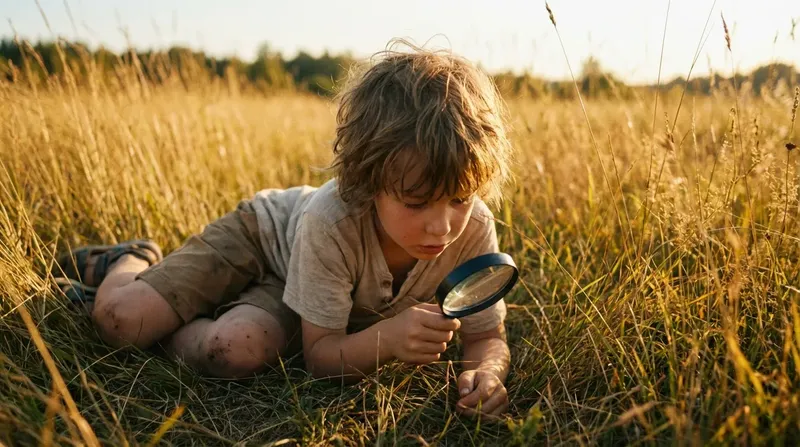
Take a walk in the woods with a four-year-old. Watch them examine every stick, every bug, every puddle. Notice how they ask questions you haven’t thought to ask. Notice how they’re not bored for a single second.
That’s not a child who needs to be taught how to learn. Whether we’re wise enough to stay out of the way is a different question, and not one the research settles.
Not sure which approach fits your family?
Take our free quiz and get personalized recommendations based on your child and your values.
Take the Quiz