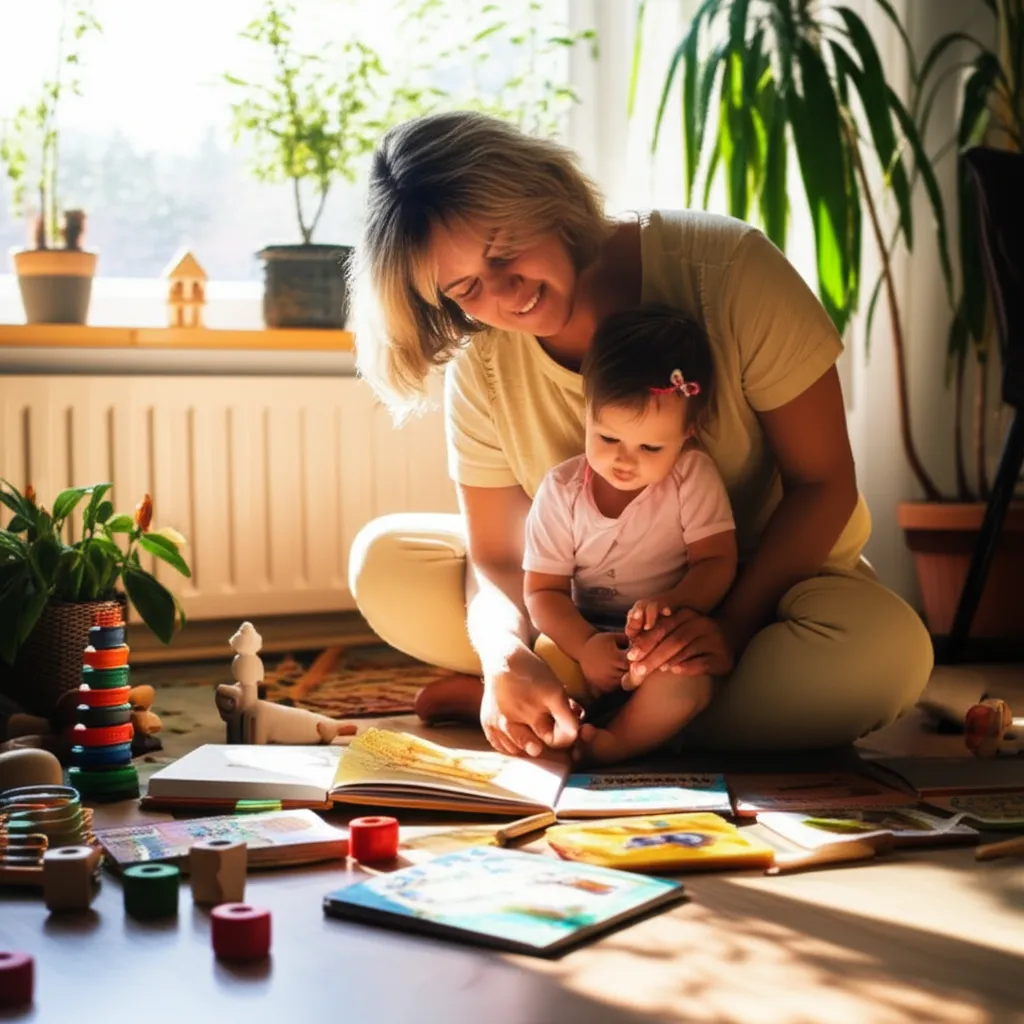
Reggio Emilia Education for Newborn
The Reggio Emilia approach begins at birth with a profound respect for the infant as a capable, curious being who is already making meaning of the world. In the first three months, this means designing an environment that honors the newborn's sensory awakening — soft natural light, carefully chosen textures, and unhurried rhythms that allow the baby to observe and absorb at their own pace. The Reggio infant-toddler centers in Italy (nidi) accept babies as young as three months, and the philosophy that informs those spaces applies from day one. At this stage, the "hundred languages" of expression are just beginning to emerge through gaze, sound, movement, and touch. A Reggio-inspired approach to newborn care pays close attention to these earliest communications, treating every coo, grasp, and moment of sustained eye contact as meaningful dialogue. Parents and caregivers become the first documenters, noticing patterns in what captures the baby's attention and responding with intention rather than assumption. The environment as third teacher takes on special significance for newborns. Rather than filling the space with bright plastic stimulation, a Reggio-inspired nursery offers carefully curated visual elements — a single mobile of natural materials, a mirror placed at floor level, fabrics in muted earth tones that invite calm focus. The goal is not stimulation for its own sake but an environment that communicates respect, beauty, and trust in the infant's innate capacity to engage with the world.
Key Reggio Emilia principles at this age
The image of the child as competent from birth — even a newborn is an active participant in relationships, not a passive recipient of care
Environment as third teacher: designing the nursery and care spaces with intention, using natural materials, soft lighting, and uncluttered aesthetics that support calm observation
Reciprocal relationships — caregiving routines (feeding, diapering, bathing) are treated as moments of genuine connection and dialogue, not tasks to rush through
The hundred languages begin here: recognizing that gaze, cry, grasp, and body tension are the newborn's first expressive languages
Documentation as a practice of attention — photographing, journaling, and reflecting on the newborn's responses to build understanding over time
A typical Reggio Emilia day
Reggio Emilia activities for Newborn
High-contrast mobile study — hang a simple mobile of black and white geometric shapes made from cardboard at the baby's focal distance (8-12 inches), rotating it weekly to introduce new forms
Mirror exploration — place a shatterproof mirror at floor level beside the baby's mat so they can discover their own reflection during tummy time
Texture baskets — gather 4-5 natural fabric swatches (silk, linen, wool, cotton, muslin) and gently brush them across the baby's hands and feet during alert periods
Light and shadow play — position the baby near a window where tree branches or curtains create shifting shadow patterns on a white surface
Vocal call-and-response — when the baby coos or vocalizes, pause, then mirror the sound back, creating an early conversational rhythm
Nature sounds immersion — open a window during alert time to let birdsong, rain, or wind sounds enter the space, observing which sounds capture the baby's attention
Parent guidance
Why Reggio Emilia works at this age
- Establishes a respectful, observation-based relationship from the very beginning, setting the tone for years of attuned parenting
- The emphasis on environment over stuff helps parents resist consumer pressure and create genuinely calming spaces for overwhelmed newborns
- Treating caregiving routines as relationship-building aligns perfectly with attachment research and gives exhausted parents a framework for finding meaning in repetitive tasks
- Documentation practice started this early creates a rich longitudinal record of the child's development and emerging interests
Limitations to consider
- The Reggio approach was developed for group care settings, and translating its community and peer-interaction elements to a home with a single newborn requires significant adaptation
- Sleep deprivation makes sustained observation and documentation genuinely difficult — parents should not feel guilty about survival mode in these early weeks
- Without access to a trained pedagogista or atelierista, parents may struggle to interpret their observations or know how to respond to what they notice
- The emphasis on aesthetics and natural materials can feel financially exclusionary or create pressure to have a picture-perfect nursery, which misses the point entirely
Frequently asked questions
Isn't my newborn too young for any educational approach?
Reggio Emilia at this age isn't about education in the academic sense — it's about how you see your baby and how you design their world. It's a shift in mindset from 'caring for a helpless infant' to 'being in relationship with a capable person who happens to be very new.' That shift changes how you feed, hold, talk to, and create space for your baby, and those changes have real effects on attachment and development.
What should a Reggio-inspired nursery look like for a newborn?
Think calm, natural, and intentional. Neutral or earth-tone walls, natural wood furniture, a low mirror, one or two carefully chosen mobiles or wall images, soft natural-fiber textiles, and good natural light. Remove visual clutter. The goal is a space that says 'you are welcome here, and this world is beautiful' rather than a space that shouts for attention from every surface.
How do I document when I'm barely sleeping?
Start with one photo or one sentence per day. That's it. Use your phone's voice memo feature while feeding if writing feels like too much. The practice matters more than the format or quantity. Some days you'll notice something striking and want to capture it in detail. Other days, survival is the documentation. Both are valid.
Do I need special Reggio materials for a newborn?
No. You need natural light, a safe floor space, your own attention, and a few simple objects made from natural materials. A silk scarf, a wooden ring, a small mirror, and a simple mobile will serve a newborn beautifully for months. The most important Reggio material at this age is you — your gaze, your voice, your unhurried presence.