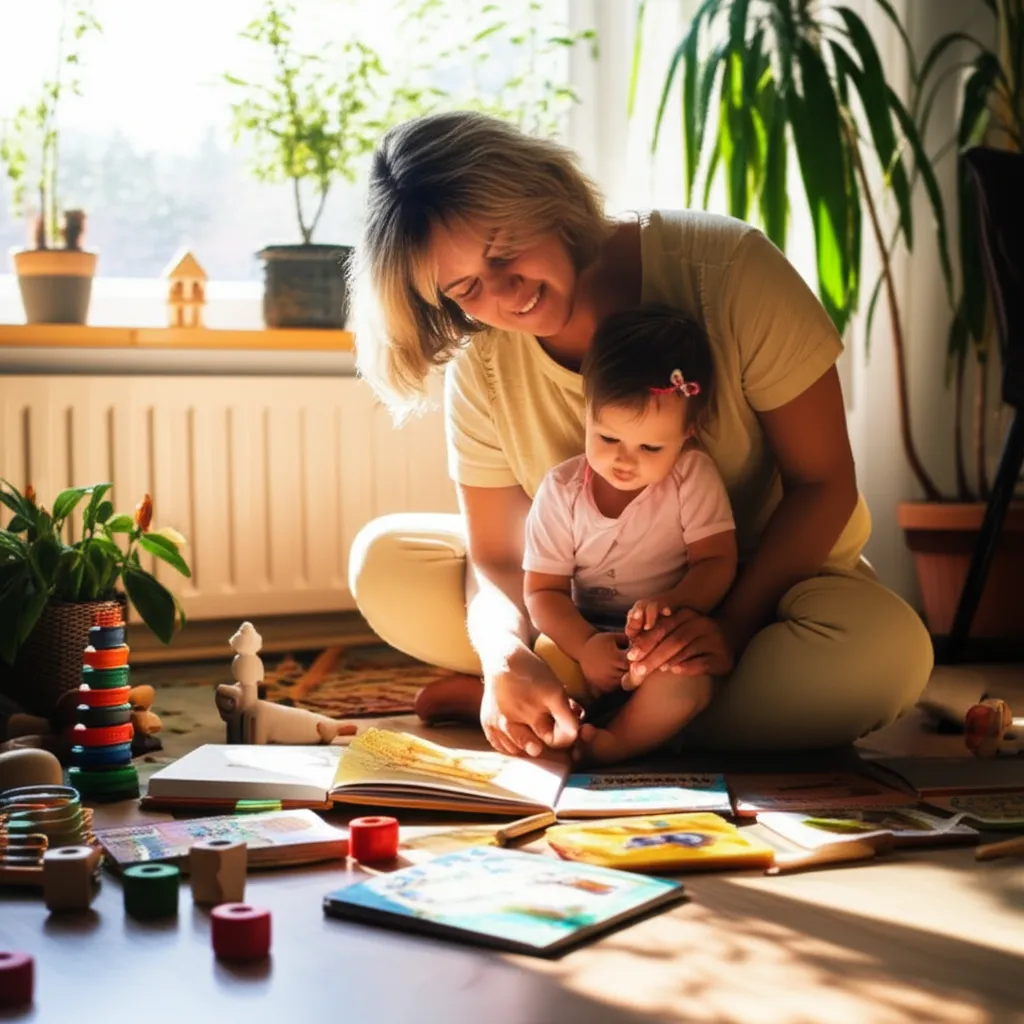
Infant
The six-to-nine-month period brings a leap in mobility and intentionality. Babies begin crawling, pulling up, and using a pincer grasp. Object permanence is developing, which means the baby now understands that things exist even when hidden. This cognitive milestone transforms how they engage with people and objects.
The six-to-nine-month window is when most babies become mobile, and that single change reorganizes everything — their understanding of space, their relationship to objects, their social world, and the way they learn. A crawling baby is not just getting from point A to point B. They are building a three-dimensional map of their environment, learning about distance, obstacles, gravity, and their own body's capabilities. Object permanence — the understanding that things continue to exist when out of sight — typically consolidates during this period, and it is a genuinely revolutionary cognitive leap. Before this milestone, when you hid a toy under a blanket, it ceased to exist in the baby's mind. Now they pull the blanket away to find it, demonstrating the capacity for mental representation. The pincer grasp (thumb and forefinger) emerges, opening up an entirely new world of fine motor possibility. Stranger anxiety appears, which is not regression but actually a sign of healthy attachment — the baby now clearly distinguishes between their people and everyone else. Baby-led weaning or the introduction of finger foods becomes both a nutritional and educational activity as the baby practices hand-eye coordination, texture discrimination, and cause-and-effect with every meal.
Key Milestones
- Crawls or scoots to reach desired objects
- Develops pincer grasp to pick up small items
- Understands object permanence and searches for hidden toys
- Babbles with consonant-vowel combinations like 'mama' and 'dada'
- Shows stranger anxiety, indicating strong attachment bonds
- Begins self-feeding with finger foods
How Children Learn at This Age
Driven by intense curiosity and desire to explore independently
Learns spatial relationships through crawling and reaching
Begins understanding simple words and gestures
Benefits enormously from safe, open floor space for movement
Explores objects with increasing intentionality and persistence
Recommended Approaches
- Montessori (freedom of movement, low shelves with rotating toys, practical life introduction)
- Baby-led weaning as sensory and fine motor exploration
- Nature-based sensory experiences (grass, water, leaves)
- Sign language introduction for pre-verbal communication
What to Expect
How to Support Learning
Best Educational Approaches
Frequently Asked Questions
My baby is not crawling yet — should I be worried?
The typical range for crawling is six to ten months, and some babies skip crawling entirely, moving straight to pulling up and walking. Bottom-scooting, army crawling, and rolling to get places are all valid forms of locomotion. What matters more than the method is that your baby is showing the desire to move independently and is developing the core strength to do so. If your baby shows no interest in moving toward objects by ten months, mention it to your pediatrician, but avoid comparing to other babies' timelines.
Is baby sign language worth the effort?
Research consistently shows benefits. Babies who learn simple signs before they can speak experience less frustration, develop verbal language at the same pace or faster than non-signing peers, and show higher confidence in communicating their needs. You do not need a formal curriculum — just consistently pairing a handful of signs (more, milk, all done, eat, help, water) with the spoken word during daily routines. Most babies begin signing back between eight and twelve months, though they understand the signs well before that.
How do I handle stranger anxiety?
Stranger anxiety is a healthy developmental milestone, not a behavior problem. It means your baby has formed strong attachments and can distinguish familiar from unfamiliar people. Respect the feeling — do not force your baby into the arms of relatives or friends to be polite. Let new people approach slowly, talk to you first while the baby observes, and allow the baby to warm up on their own terms. The anxiety typically peaks between eight and twelve months and gradually resolves over the following year.
What are the best toys for a 6-9 month old?
Objects that respond predictably to the baby's actions: a ball that rolls when pushed, nesting cups that stack and fit inside each other, a simple drop box where a ball goes in the top and rolls out the bottom, a basket of fabric scraps with different textures, wooden rings on a dowel, and containers with lids to open and close. Kitchen items work wonderfully — wooden spoons, stainless bowls, silicone muffin cups. Avoid anything battery-operated. The baby needs to be the agent, not a spectator.
Should I use a walker to help my baby learn to walk?
No. The AAP and most pediatric physical therapists advise against traditional baby walkers. They do not help babies learn to walk and actually delay walking by encouraging tip-toe movement patterns and bypassing the core-strengthening stages of crawling and pulling up. They also pose significant safety risks, particularly around stairs. If you want to support pre-walking, a sturdy push wagon that the baby controls is a much better choice — it lets them practice walking while maintaining natural posture and balance.
How do I baby-proof without limiting exploration?
Think of baby-proofing as creating freedom, not restriction. The goal is a space where the baby can explore without hearing "no" every thirty seconds. Secure heavy furniture to walls, cover outlets, gate off stairs, and remove genuinely dangerous items. Then leave accessible shelves and baskets of safe objects for the baby to discover. Lower kitchen cabinets can hold baby-safe items like wooden spoons and plastic containers — the baby feels like they are accessing the "real" world. One well-proofed room where the baby has total freedom is more valuable than a whole house of constant redirection.