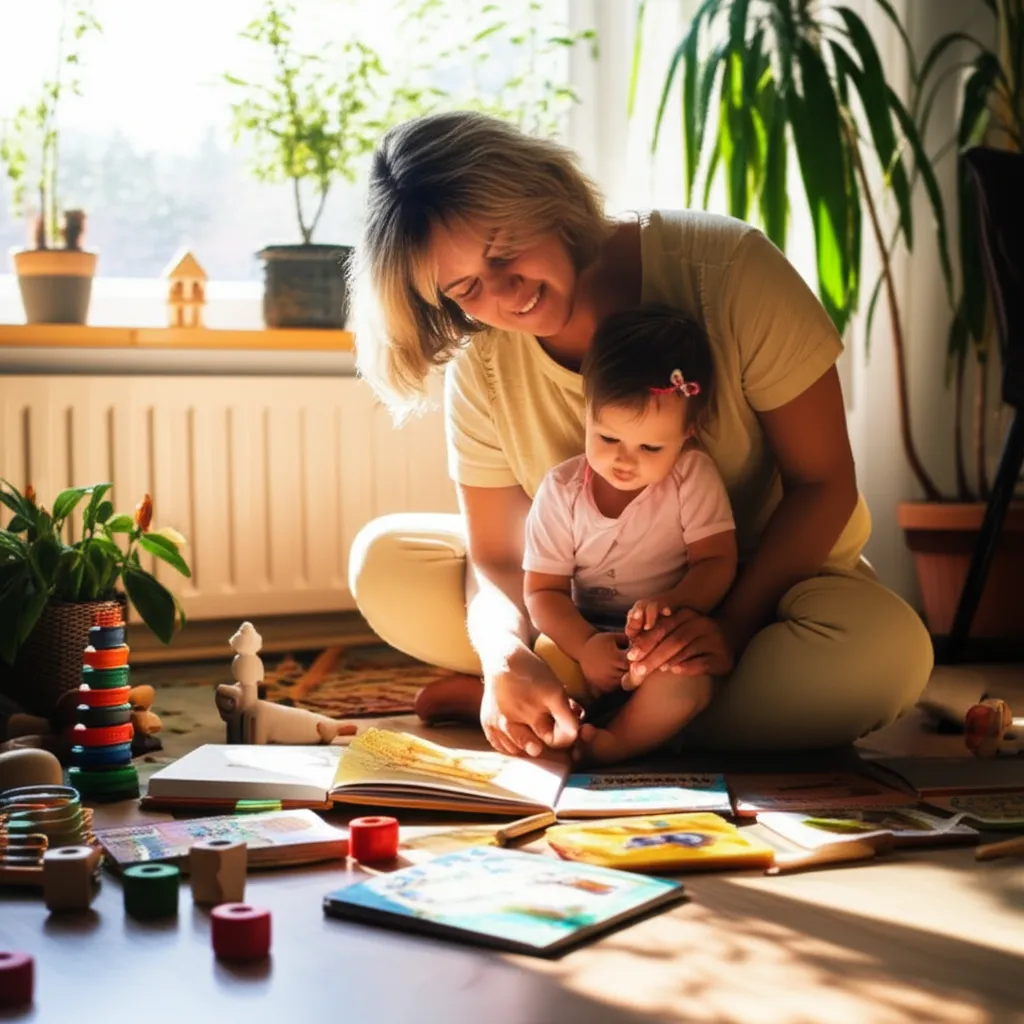
Gameschooling Education for Infant (3-6 Months)
Between three and six months, babies become active participants in play for the first time. They can grasp objects, laugh at surprises, and sustain attention for longer stretches. This is when cause-and-effect understanding really clicks — baby shakes a rattle and it makes noise, pushes a button and something happens. That's the seed of every game mechanic ever designed. Gameschooling at this age means introducing simple toys and interactions that have clear inputs and outputs. Stacking cups that nest and tumble, soft blocks that topple when pushed, texture cards to grab and mouth. The "game" is still parent-facilitated, but now baby is an active player rather than a spectator. You'll see the earliest signs of preferences — some babies love the crash of falling blocks, others prefer the quiet satisfaction of fitting cups together.
Key Gameschooling principles at this age
Cause-and-effect is the foundational game mechanic — let baby experience it through every sense
Grasp-and-release play builds the fine motor skills needed for handling game pieces later
Social games like peek-a-boo now include baby's active participation and anticipation
Mouthing objects is exploration, not misbehavior — choose game materials accordingly
Laughter is the best feedback signal; when baby laughs, you've found a winning game
A typical Gameschooling day
Gameschooling activities for Infant (3-6 Months)
Stacking cup demolition — you stack, baby swipes them down; early cause-and-effect with satisfying feedback
Texture exploration cards — different fabrics mounted on cardboard for baby to grab, mouth, and compare
Peek-a-boo with active baby participation — baby starts pulling the cloth or your hands away
Roll-and-retrieve — roll a soft ball just out of reach during tummy time to encourage reaching and early crawling motion
Mirror play — prop a baby-safe mirror at floor level; baby interacts with their reflection, building self-recognition
Singing games with pauses — songs like 'Row, Row, Row Your Boat' where you pause before the end, and baby kicks or vocalizes in anticipation
Parent guidance
Why Gameschooling works at this age
- Babies can now grasp, hold, and release — opening up a whole world of manipulative play
- Social laughter emerges, making interactive games genuinely fun for both parent and baby
- Cause-and-effect understanding blooms, which is the cognitive basis of all game mechanics
- Longer alert windows allow for more sustained play sessions
Limitations to consider
- Everything still goes in the mouth, limiting material choices
- Baby can't yet sit independently, so most play happens on the floor or in a supported seat
- Attention span is still measured in minutes, not longer
- No understanding of rules, turns, or sharing — and that's completely normal
Frequently asked questions
My baby just wants to chew on everything. Is that play?
Yes. Mouthing is how babies at this age gather information — texture, temperature, hardness, taste. When your baby mouths a wooden block versus a soft ball, they're doing material science. Choose game materials that are safe for mouthing (no small parts, non-toxic finishes) and let them explore. The hand-to-mouth coordination they're building is the same pathway that will eventually let them pick up a game piece and place it precisely.
Should I be introducing structured learning games?
No. At 3-6 months, all learning is happening through free exploration and social interaction. Products marketed as 'educational games' for this age are usually just toys with good packaging. A set of nesting cups, some textured balls, and your undivided attention are better than any branded learning system. The structure comes from your responsiveness, not from the toy's design.
When will my baby be ready for actual games?
Simple cooperative games with parent support start becoming possible around 18-24 months, and very basic board games work around age 3-4. But what you're doing right now is gameschooling — it just doesn't look like board game night yet. Every round of peek-a-boo teaches turn-taking. Every tower knocked down teaches cause and effect. You're building the player before you introduce the game.